Stocks
Why I’m Short Oil Here: My December USO Put Trade
Oil has exploded higher on geopolitical risk. I’m betting that the fear premium proves harder to sustain than the market currently believes.
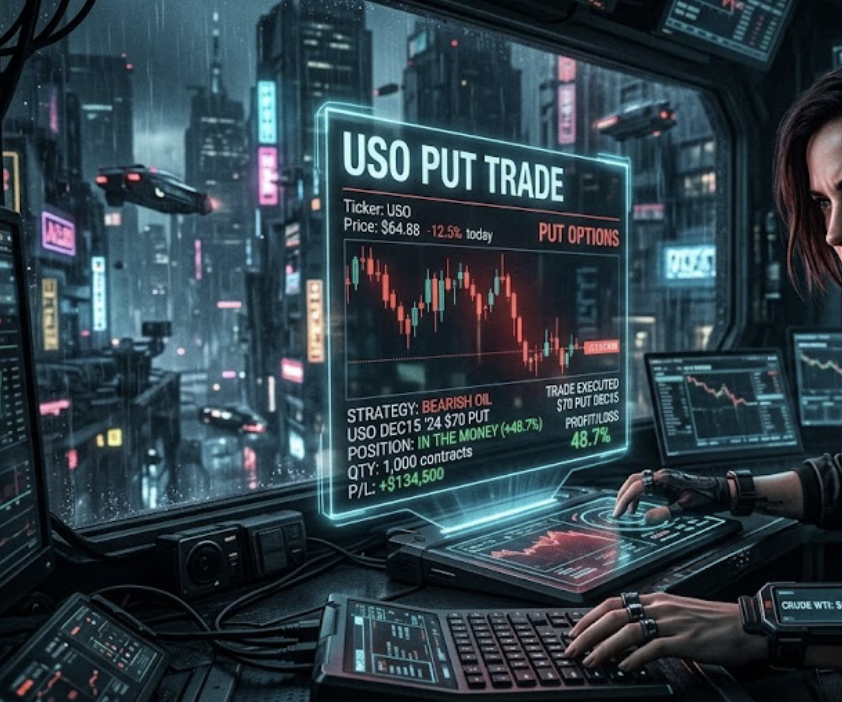
Oil is having another one of those moments when geopolitics appears capable of overwhelming almost every other fundamental input.
I recently took the other side.
With the United States Oil Fund, USO, trading around $140, I bought the December 18, 2026 $150 put, giving the position nearly five months for my thesis to develop.
The trade is straightforward: I believe the recent move in oil has gone too far, too quickly, and that crude prices can retreat substantially if even part of the geopolitical premium currently embedded in the market begins to unwind.
This is not a bet that the Middle East suddenly becomes peaceful. It is a bet that markets have a tendency to price the most frightening scenario faster than that scenario actually materializes.
Oil has become a geopolitical trade
The immediate bullish case is not difficult to understand.
On July 23, Brent crude pushed above $100 per barrel, while West Texas Intermediate jumped above $92, following attacks on Saudi oil tankers, escalating Houthi activity around the Red Sea and renewed concerns surrounding the Strait of Hormuz. Brent rose roughly 7% in a single session while WTI gained more than 6%.
The speed of the move is even more striking when you zoom out.
WTI spot prices were around $70 in early July, reached roughly $81 by July 17 and have now moved sharply higher again.
That is an enormous repricing in a matter of weeks.
And it comes after an already extraordinary year for crude.
The conflict involving Iran previously pushed Brent as high as roughly $126 before prices collapsed back toward $70 in early July. Reuters reported that despite forecasts earlier this year suggesting oil could reach $150 to $200 if Hormuz disruptions became severe, physical supply, alternative shipping routes, rising U.S. production and weaker Chinese demand prevented those extreme scenarios from becoming reality.
That history matters to my trade.
Oil has already demonstrated in 2026 that geopolitical fear can create enormous spikes — and that those spikes can disappear surprisingly quickly.
My trade: USO December $150 puts
Rather than short crude futures directly, I expressed the view through USO.
USO is designed to reflect movements in light sweet crude through oil futures contracts, although it is important to understand that USO is not the same thing as owning physical WTI crude. Its performance is affected by the futures contracts it holds and the process of rolling those contracts over time.
My position:
Underlying: USO
USO price at entry: approximately $140
Position: Long put
Strike: $150
Expiration: December 18, 2026
Choosing the $150 strike puts the option in the money from the beginning rather than using a cheap far-out-of-the-money lottery ticket.
That is deliberate.
I want meaningful downside exposure if USO begins rolling over while giving the thesis enough time to survive the violent daily fluctuations that have become normal in energy markets.
The expiration also pushes the trade beyond the immediate news cycle.
I am not trying to predict tomorrow’s headline from Tehran, Washington, Riyadh or Yemen.
I am betting on where the oil market looks once several months of supply responses, demand destruction, diplomatic developments and changing positioning have had time to work through the system.
The fundamental picture looks very different from the headline picture
This is where the bearish thesis gets interesting.
Before the latest escalation, the U.S. Energy Information Administration was expecting global oil production and trade flows to recover significantly following the reopening of the Strait of Hormuz.
Its July forecast projected Brent averaging just $74 during the third quarter of 2026 and eventually falling toward an average of $65 during 2027 as global inventories rebuild.
Obviously, geopolitical developments since that forecast have increased the near-term risk considerably.
But supply does not disappear simply because futures prices spike.
Higher prices create powerful responses.
Producers have an incentive to increase output. Consumers reduce usage. Governments can release strategic reserves. Shipping routes adjust. Refiners change sourcing. Traders who were caught short eventually become buyers — but once that positioning clears, there may be fewer incremental buyers left.
OPEC+ is already discussing additional production increases as the market deals with the latest disruption.
That does not guarantee lower oil.
It does mean the market has mechanisms that begin working against extreme prices.
History is full of oil spikes that looked permanent
This is probably the biggest reason I am comfortable taking the trade.
Oil markets have repeatedly convinced investors that a new permanently higher price regime has arrived.
Then something changes.
During the Russia-Ukraine shock in 2022, WTI reached a monthly average of roughly $114 per barrel in June as sanctions and supply fears swept through energy markets.
By the second half of the year, crude was falling again as recession concerns, weaker demand, strategic reserve releases and increased supply began overpowering the geopolitical premium. Brent finished the year around $85.
And then there is the ultimate example of oil-market excess.
In April 2020, WTI futures briefly traded below zero, reaching approximately -$40 per barrel intraday as collapsing demand collided with insufficient storage capacity.
Obviously today’s situation is completely different.
But that is precisely the point.
Oil is one of the most reflexive major markets in the world.
Shortages create high prices.
High prices encourage production and destroy demand.
Oversupply creates low prices.
Low prices discourage production and eventually stimulate demand.
The cure for high oil prices has historically been high oil prices.
What could make this trade wrong
There is one enormous risk to the thesis: a genuine sustained disruption to global physical supply.
The Strait of Hormuz and Bab el-Mandeb are not theoretical concerns. Together, the shipping routes affected by the current conflict touch an enormous portion of internationally traded energy supplies.
If tanker traffic becomes materially impaired for months rather than days or weeks, today’s prices could look cheap.
Goldman Sachs has suggested Brent could move above $120 if disruptions persist.
That is the scenario I am betting against.
My expectation is that oil’s latest surge ultimately behaves more like previous geopolitical spikes: violent on the way up, extremely convincing near the top, and vulnerable once the market realizes that the worst-case scenario is not the only possible outcome.
I’m betting against the fear premium
There is no question that crude deserves a geopolitical premium right now.
My disagreement with the market is over how large that premium should be and how long it can survive.
USO around $140 gave me the setup I was looking for.
The December 18 $150 put gives the trade time.
And after watching crude travel from extreme fear to relative calm and back again several times this year, I believe the asymmetry has shifted.
Oil may absolutely move higher before this trade works.
But over the next several months, I am betting that supply adaptation, weaker demand at elevated prices and some eventual normalization of geopolitical risk pull crude back toward fundamentals.
For now, I’m short oil.

Written by
Bryan
Independent technology coverage focused on useful context, real-world experience, and honest recommendations.